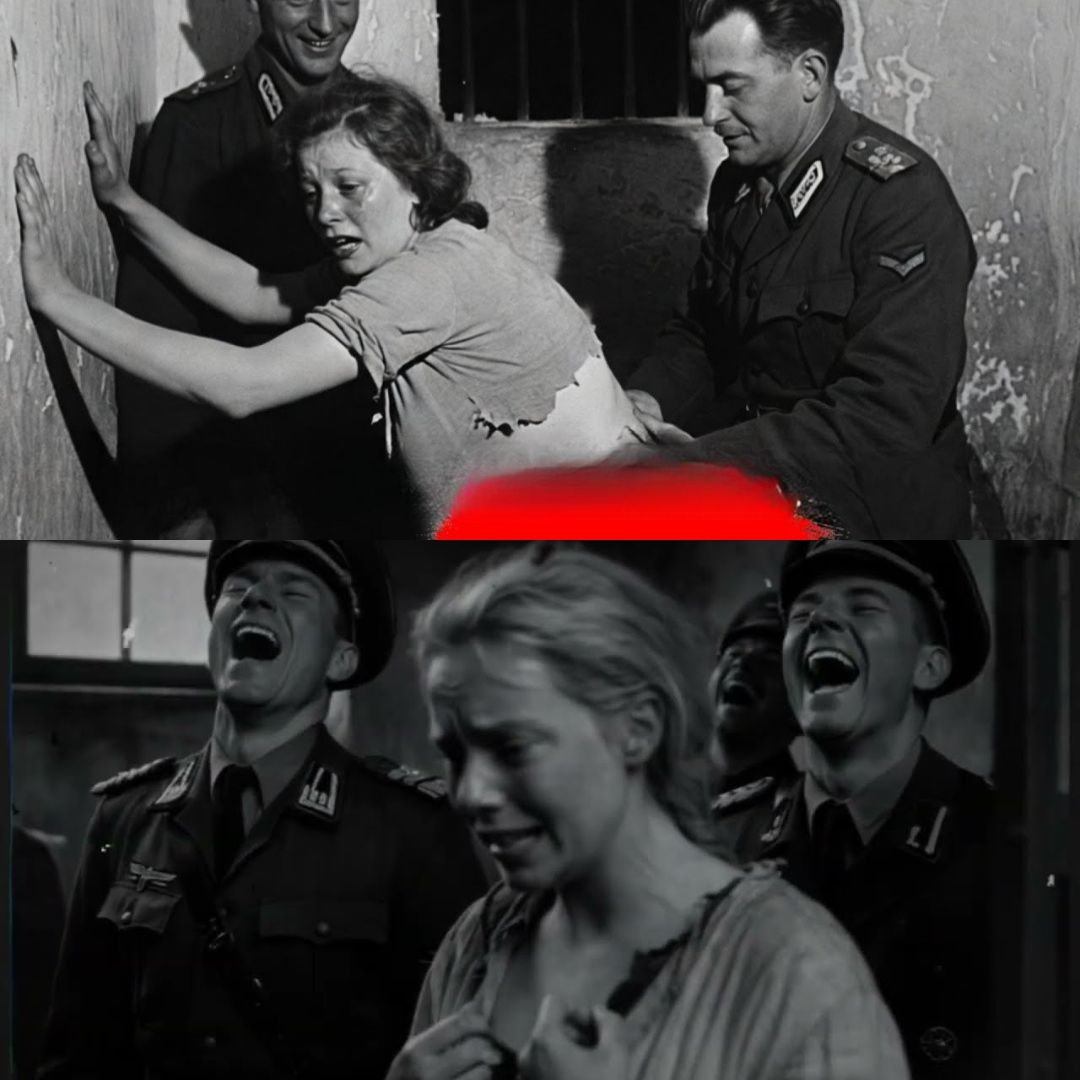
The dark secret of the Third Reich: the empire’s children suffered things worse than death.
My name was Elsa. I was 19 years old in 1942 and lived in a small village in northern France, under the grey shadow of the occupation. Most people prayed to go unnoticed, but I couldn’t be invisible. I carried on my face a curse that, in other times, would have been a blessing: I was blonde, with radiant blonde hair, and I had deep blue, almost transparent eyes.
My mother told me to hide, fearing the soldiers’ lust. She was thinking of the common abuse, the kind that leaves marks on the skin and tears on the pillow. She was wrong. What awaited me was far worse than animal instinct: it was cold science.
Everything changed on a Tuesday in November. A spotless black pickup truck, bearing the SS insignia, pulled up in the square. Two men with briefcases got out and went into the town hall. An hour later, the mayor, trembling, knocked on our door: “They want to see you.” They had census lists; they knew my age and what I looked like. I didn’t have time to run. Two soldiers were waiting for me and, with a courtesy that chilled my blood, opened the car door.
We arrived at an old castle surrounded by a magnificent park. It wasn’t a prison; the fences were high, but the gardens were immaculate. This beauty was terrifying, for one doesn’t put prisoners in palaces; one puts something precious. In the marble hall, I saw five or six other girls, all young, blonde, and light-eyed. We were a collection of Aryan dolls lined up for inspection.
A man entered: Obersturmbannführer Klaus von Ritoven. He was tall, thin, with a face sculpted from cold marble. He examined each girl as if they were racehorses, analyzing teeth and bone structure. When it was my turn, he removed his glove and touched my face. His hand was cold. He complimented my facial features and hair color, treating me like the missing piece in his collection. He ordered that I be validated as “Class A” and taken to room number four.
The room was luxurious, with abundant food the likes of which I hadn’t seen in years. But that luxury wasn’t free. An SS officer came in and said I should look beautiful for the evening: “You’re going to offer the Führer a gift, a living gift.” At that moment, I understood everything. It wasn’t a work camp; it was a breeding farm. I was a genetically selected breeding mare.
Through the window, I saw dozens of baby carriages in the park, pushed by women walking in mechanical silence. At 10 p.m., Klaus entered my room. He wasn’t an ordinary abuser; he was a scientist in his laboratory. He said it was a sacred duty: to unite our “perfect” genes to build a thousand years of the future. When I tried to refuse, he was clear: “Your consent isn’t necessary. The Reich takes what it needs, and tonight it needs your womb.” The real hell wasn’t the pain, but his absolute conviction that he was creating a masterpiece.
Part 2: The Nine-Month Ordeal
The following days were marked by logistical visits. Klaus no longer used force; he had broken my will through authority. I had become docile, staring at the ceiling while he used my body. Life in the mansion followed a military-like rigor: a diet rich in protein and mandatory walks. We were called “the Führer’s brides.”
I met Sophie, a young Belgian woman. When she confessed to me, terrified, that she hadn’t gotten pregnant, she disappeared the next day. In that place, if the soil was barren, the field was discarded. Pregnancy was no longer a fear, it was my only shield.
Six weeks later, the doctor confirmed: “Positive.” Klaus felt a frightening joy. He didn’t hug me; he touched my belly and murmured, “My son.” I was no longer Elsa; I was the reliquary of his treasure. I began receiving vitamins and ultraviolet light to strengthen the baby’s bones. Klaus now came to give me lessons about the “new man” I was carrying, playing Wagner records to “shape the character” of the fetus.
In the fourth month, I felt the baby move. I cried when I realized that this life was innocent, that it was my blood too. I tried to whisper to him in the dark: “You are not his, you are mine.” But I didn’t know that, in that mansion, the word “mine” didn’t exist for women like me.
The illusion of security crumbled when Ingrid, another pregnant woman, lost her baby during childbirth. She was sent to a labor camp from which no one returned. I understood that my son was my hostage: as long as he was alive and healthy, I would be a princess; the moment he was gone, I would be disposable trash.
Part 3: The Birth and the Theft
On August 14, 1943, the contractions began. I was taken to a cold operating room, where I was strapped to the table. Klaus watched everything with icy concentration. When the baby was born and cried, he wasn’t handed to me. Klaus held him up like a trophy and named him: “Siegfried, welcome to the Reich.”
I begged to see him, but Klaus looked at me with complete indifference: “He needs care. You’re tired, sleep.” I watched my son disappear down the hallway. The doctor gave me an injection, and the world went dark. They had taken the pearl and thrown away the oyster.
I woke up in an empty room. The luxury had vanished. I went out into the corridor and found the infirmary. Among dozens of cribs, I found number 412. It had my mouth on it. When I tried to touch it, the supervisor shooed me away: “This isn’t your son. He belongs to Germany.” I was forced to gather my things. Klaus didn’t even look at me as I passed; I had already fulfilled my duty.
I was thrown into a truck with other women who had also just given birth. We were abandoned in a beet field. I walked for two days to get home, feverish and with empty breasts. My parents received me with shame. The village hated me, calling me “the soldier’s bitch.” No one cared about the violence; for them, my beauty was my fault and my womb was my crime.
Part 4: The Quest and the Final Sacrifice
In 1944, liberation came, but for me it was a public execution. I was dragged away by neighbors, my hair was brutally shaved off in the middle of the square, and a swastika was painted with tar on my forehead. My parents kicked me out to save the bakery. I became a ghost with a single goal: to find my son.
I spent four years traveling through ruined Germany. In 1949, the Red Cross located Siegfried, now called Hans, adopted by a family in Bavaria. I went there and saw him playing in the garden. He had my eyes, but Klaus’s smile and chin. He was the “new man.”
I saw Hans embrace his adoptive mother and call her “Mommy.” I realized that if I crossed that street, I would destroy his innocence with the poison of his origin. To love him meant letting him go. I returned to France, changed my name, and lived an invisible life. I never had other children; my womb was scorched earth.
Today I am 98 years old. Klaus died unpunished in Argentina. Hans must be an old man now, never knowing that his real mother loved him enough to abandon him. My war had no medals, only scars. I told this story so that the theft stops, so that they know that thousands of children were manufactured and stolen in the name of an insane idea. Purity does not exist; blood is red for everyone. I hope that, in the next world, I can finally embrace my son—not the Siegfried of the Reich, but my Théo.